
Semantic Resistance: Why Your Differentiation May Already Be Inside GPT

I would like to introduce, through this article, a concept I have been working on for several months: semantic resistance.
The idea starts from a simple but uncomfortable observation.
You - as a company - may have spent 20 years building your differentiation. A refined purchasing process. A due diligence methodology. A proprietary design vocabulary. A candidate scoring framework. A sales playbook. An expert assessment protocol.
These intangible assets are what create your market value.
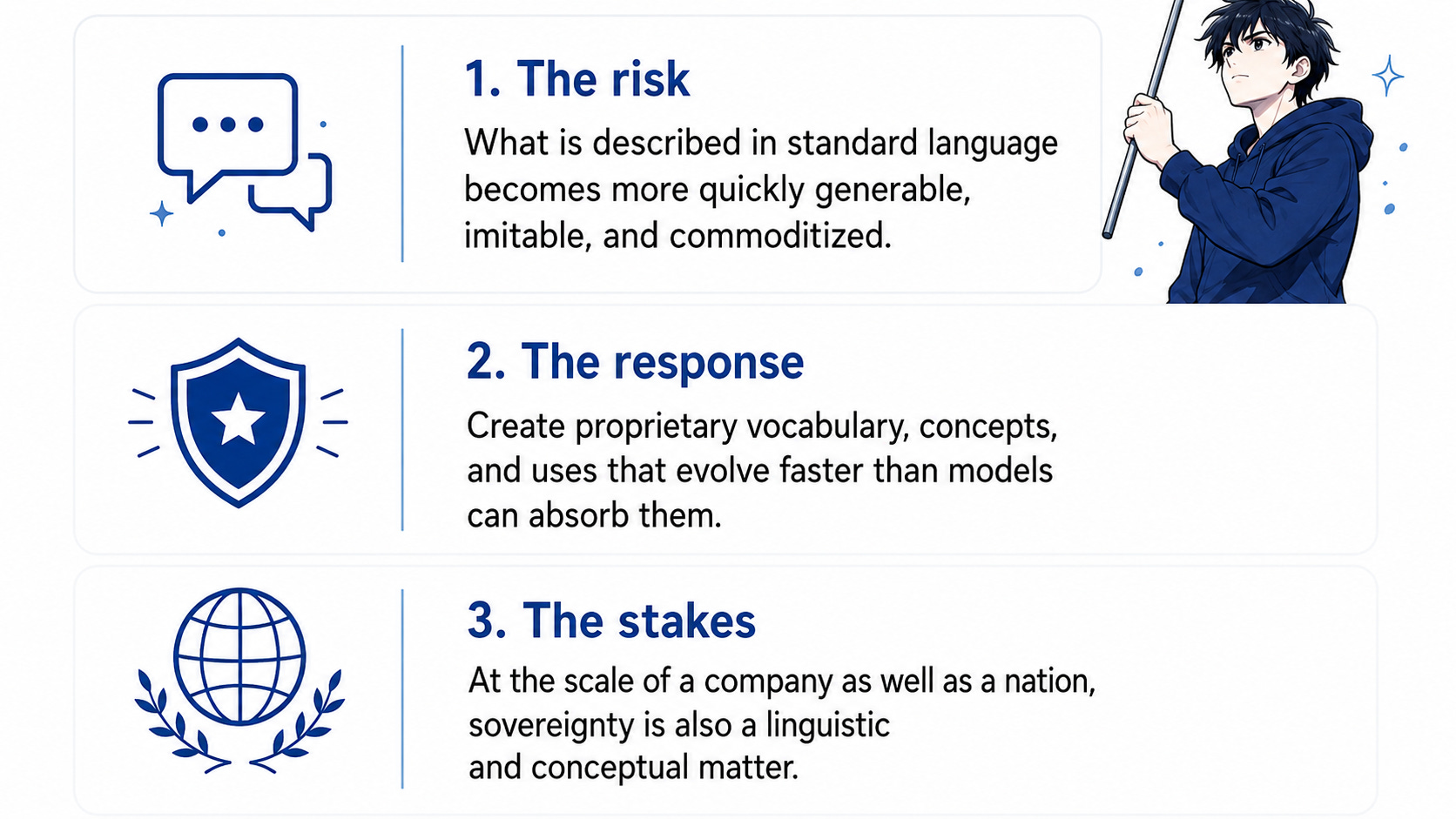
Bad news: an LLM does not possess your know-how. But it already possesses, or soon will possess, the common language in which you describe it. And it is through this common language that your differentiation gradually becomes generable, imitable, and then commoditized.
So everything you describe in standard English, standard French … already belongs to it. Or soon will, in three months, in one or two model versions.
The boundary between “proprietary know-how” and “standard generative content” is moving faster than most organizations realize.
S3m@nt1c r3s1st@nc3 proposes two defensive moves.
1. Make the language of your differentiation harder to absorb.
This does not mean becoming obscure.
It means separating two languages:
the public language you use to be found, understood, and cited by AI systems,
and the internal language through which your organization actually thinks, decides, scores, prioritizes, diagnoses, and acts.
GEO (Generative Engine Optimization) pushes companies to expose more and more of the first language.
The danger is when they start exposing the second one.
That is not visibility. That is self-commoditization.
When you give models a clean verbal blueprint of your deepest know-how, you are not just optimizing for AI search.
You are making your differentiation easier to absorb, reproduce, and erase.
Stop describing what you know how to do with everyone else’s words.
Forge a proprietary vocabulary. Give internal names to your methods, your steps, your categories. Change your language faster than LLM builders can assimilate it.
This is the defense of the weak against the strong.
Radio Londres (the french resistance from the UK) spoke in metaphors: “Les sanglots longs des violons de l’automne…” Incomprehensible to the occupier, perfectly clear to those who needed to understand.
The principle is exactly the same.
Universal clarity is commoditizable. A shared code among insiders is not.
2. Capitalize on usage: cumulative value AND creative value.
Every time one of your key intellectual processes is run, two things happen at the same time.
You accumulate: friction data, field feedback, proprietary signals that only you see because only you are in a position to see them.
And you create: new symbols, new terms, new distinctions to name what you discover as you move forward.
Usage produces both.
This is what resists absorption in practice: not only because you see what others do not see, but because you are constantly inventing the vocabulary to describe it — faster than a model can learn it.
The same reasoning applies at the scale of a nation.
A country that only speaks the language of dominant models — the English of Californian training data — has already lost cognitive sovereignty over its own economy.
Its legal concepts, administrative categories, regulatory frameworks, and strategic thinking pass through models it did not train, does not control, and that were optimized on reference systems other than its own.
I admire Mistral’s effort, but AI sovereignty cannot be reduced to producing a European OpenAI.
AI sovereignty is not only a matter of infrastructure or chips. It is first and foremost a linguistic and conceptual issue.
Which corpora? Which language? Which business concepts specific to a given industrial fabric? Which models trained on what?
Deprive the Large Language Model of its raw material and it becomes nothing more than a naked king: a Large Commodity Model.
For any country that wants to matter in tomorrow’s economy, semantic resistance is the same battle fought at two scales: the company and the nation.
We do not protect ourselves from AI, or from the powers that dominate it — the US and China — by ignoring it.
We protect ourselves by making it impossible for AI to absorb what makes us singular.
#SemanticResistance #LLM #AISovereignty
Lucid diagnosis